

You've Finished Painting It. Now Where Does It Actually Go?
5 min read

Most guides about miniature painting stop the moment the varnish dries. Nobody tells you what to actually do with the thing afterward, and it's a real question: a painted figure that just sits wherever it landed on the table tends to end up in a drawer within a month, not because anyone decided to put it away, but because it never had a proper spot in the first place. Where and how you display it matters almost as much as the paint job itself.
A figure on a low shelf near the floor, or up on top of a cupboard where nobody actually looks, gets forgotten fast. Eye level on a console table, a bookshelf, or a bedside table is what makes it register every time you walk past, which is really the whole point of finishing it. If you've got more than one piece, group two or three together rather than spacing them out across a room; a small cluster reads as a deliberate little collection, while one figure alone on a big empty shelf can look like it's still waiting to be unpacked.
If the finish already looks a little dull or unsealed, that's a separate, fixable problem: our piece on getting a display-quality finish covers the varnish step, which is what actually protects the paint from dust and handling in the first place.
For most homes, open shelf display is completely fine. A figure that's properly varnished can handle normal dusting and years on an open surface without issue. A case only really earns its keep in two situations: a home with a lot of dust or a kitchen nearby, or a piece you specifically want protected because it's a milestone gift, a wedding piece, or something for a child's room where little hands can reach it. A basic clear acrylic dome or box runs roughly ₹300 to ₹700 depending on size, and it's the cheapest way to keep a finish looking fresh for years instead of getting a light film of dust every week.
A shadow box, a deep-set frame with room for the figure plus a couple of small objects, is the better option when the piece is really about a moment, not just a decoration. A couple's figure paired with a folded ticket stub from the day, a pressed flower, or a small handwritten date card turns it into something closer to a framed memory than a shelf ornament. It works particularly well as an anniversary or engagement gift, since it gives the recipient somewhere to actually hang it rather than find shelf space for it. Expect to pay around ₹800 to ₹1,500 for a decent one locally or on any of the big marketplaces, more if you go custom with engraving on the frame itself.
Cleaning it, without wrecking the paint
A soft, dry makeup brush or a clean paintbrush is the right tool for dusting a painted miniature, not a damp cloth. Wiping with anything wet, even lightly, can drag pigment off fine detail like eyes or trim before the varnish has fully cured, and even after it's cured a wet cloth risks lifting varnish at raised edges. A quick pass with a dry brush once a week is genuinely enough.
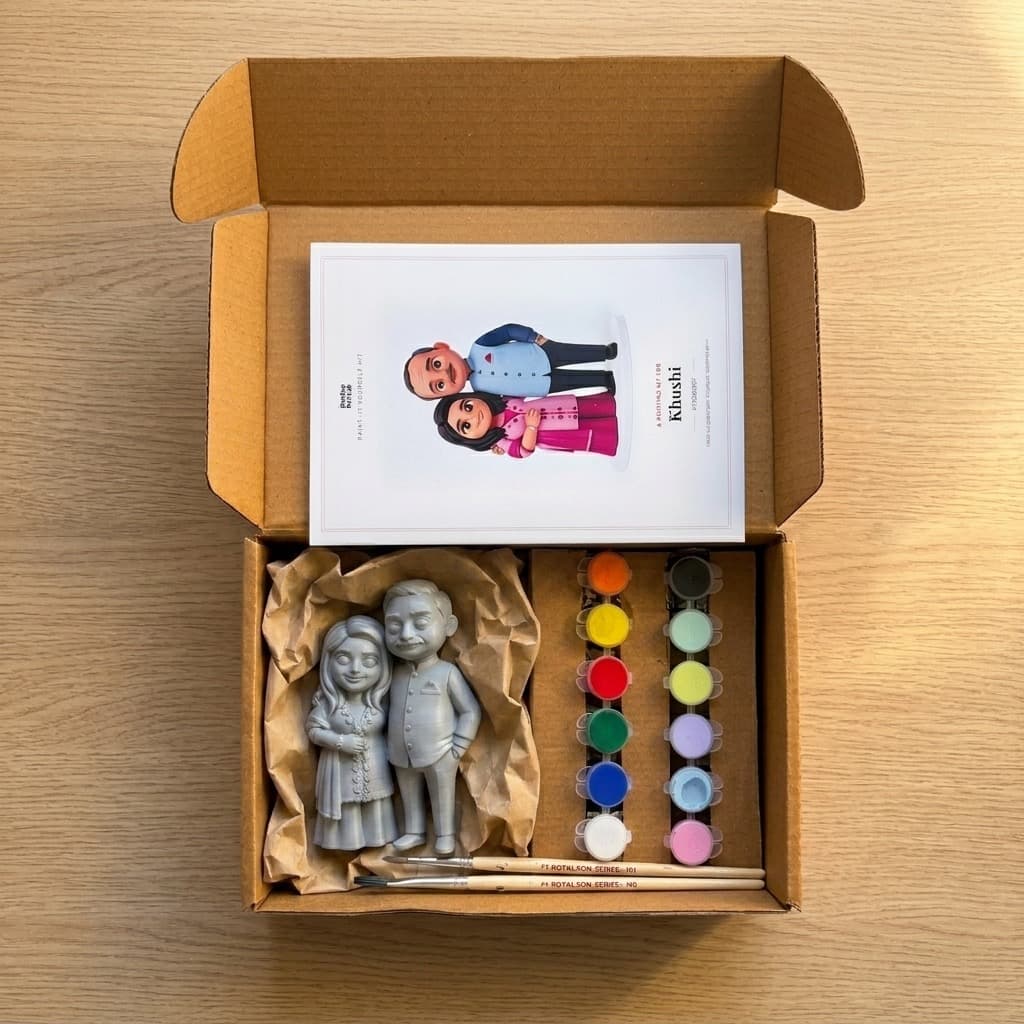
If you're painting a figurine specifically because it's a keepsake rather than a hobby project, it's worth deciding on its display spot before you even start painting, the same way you'd pick a frame before hanging a photo. We build our own kits (a figure sculpted from your own photo, unpainted, with numbered pots and a guide) around a black pedestal that ships with every order, so the base is already sorted; where it goes on your shelf after that is entirely yours to figure out.
No, not if it's properly varnished. A case is a nice-to-have for dust-heavy homes or a piece you want extra protected, not a requirement for normal open-shelf display.
Only really from prolonged direct sunlight. Kept out of a sunny windowsill, a varnished acrylic paint job holds its colour for years with nothing more than occasional dry dusting.
It lets you display the figure alongside a small object tied to the memory, a ticket, a pressed flower, a date, which turns it into something closer to a keepsake frame than a standalone ornament. It's mostly worth it for anniversary, wedding, or milestone pieces.
Painting & Together-Time
A wrong colour or a smudged line on a half-painted figurine feels final. It almost never is. Here's how to actually rescue it.
4 min read

Painting & Together-Time
A kit gives you paint and brushes. Here's the short, cheap list of everyday things you'll also want on the table before you start.
4 min read

Painting & Together-Time
The parts nobody mentions beforehand: how long it really takes, what goes wrong halfway through, and why the crooked bits end up mattering.
4 min read