

What to Practice On Before You Paint Your First Miniature
4 min read
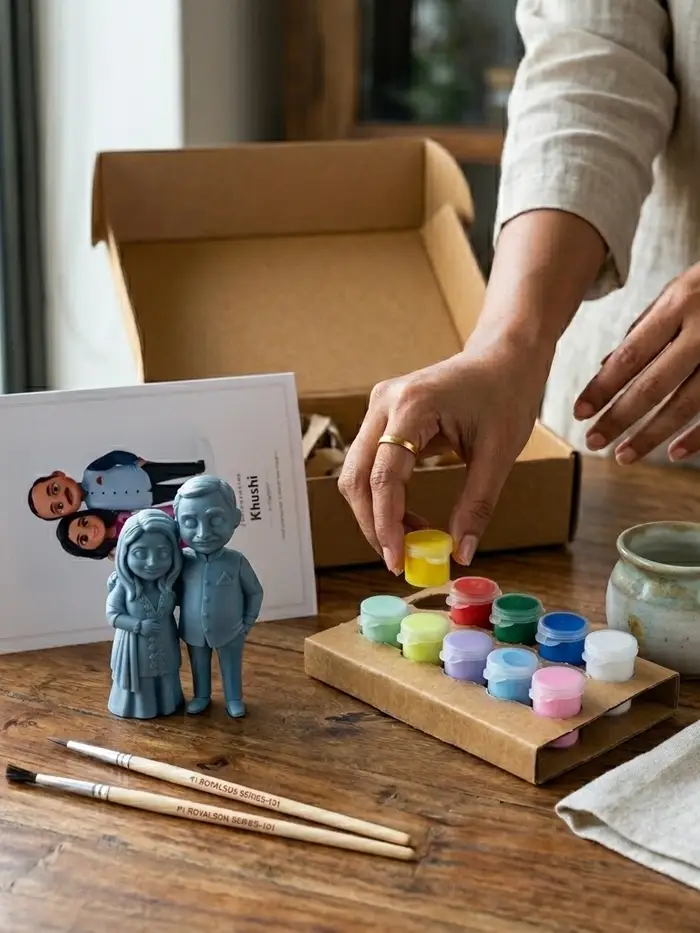
The instinct with anything new is to get straight to the real thing. With a miniature, that instinct works against you a little, because your first ten minutes with a loaded brush are also the clumsiest ten minutes you'll ever have with one. It makes sense to spend those minutes on something that doesn't matter before you spend them on the figure that does.
Not everything needs a trial run. Colour choice, for instance, is usually already decided for you by a photo or a numbered guide, so there's nothing to rehearse there. What genuinely benefits from a warm-up is the physical handling: the stuff your hand has to learn by doing, not by reading about.
It doesn't need to be anything special, and it definitely doesn't need to look good afterwards. An old terracotta diya, a wooden spoon, a chipped plastic toy nobody will miss, or even the inside of the kraft box your paint kit arrived in all work fine. The only real requirement is a surface with some shape to it, because a flat sheet of paper won't teach your hand anything about painting around a curve or a corner.
Ten minutes is enough
This isn't a rehearsal you need to take seriously. Load the brush a few times, paint two thin coats over the same small patch, place a handful of dots. Once your hand stops feeling foreign around the brush, you're ready for the real piece.
Blending and gradients get a lot of attention online, but they matter far less on a small painted keepsake than people expect. Most figurine styles, ours included, use flat, defined blocks of colour rather than soft shading, so there's no need to practice a skill you won't actually be using. If you're painting one of our kits, the guide's numbered pots already tell you exactly what colour goes where, which means this practice round only needs to build brush control, not colour judgement. That's genuinely one less thing to worry about before you start.
If your figure has already arrived and you're past the point of wanting a separate practice object, painting the base coat on the least visible area first (the back of a jacket, the sole of a shoe) works almost as well. You get the same warm-up, just on a part nobody's going to be looking at closely. For a fuller rundown of what tends to go wrong even after a warm-up, our most common beginner mistakes piece covers the fixes for each one.
The colour decisions are already made for you, so what's left to practice is purely physical: loading the brush, thin coats, staying inside an edge. Ten minutes on something disposable still helps, even with a guide in hand.
Use the packaging your kit arrived in, or start on the least visible part of the actual figure. You'll get the same warm-up either way, just without a separate object.
Ten to fifteen minutes is usually enough to feel less clumsy with the brush. There's no benefit to stretching it out further; the real learning happens on the piece you actually care about.
Painting & Together-Time
A wrong colour or a smudged line on a half-painted figurine feels final. It almost never is. Here's how to actually rescue it.
4 min read
Painting & Together-Time
A kit gives you paint and brushes. Here's the short, cheap list of everyday things you'll also want on the table before you start.
4 min read
Painting & Together-Time
The parts nobody mentions beforehand: how long it really takes, what goes wrong halfway through, and why the crooked bits end up mattering.
4 min read